In the derivation of our formulas so far it has been necessary to apply the General Rule, p. 29 [§ 31] (i.e. the four steps), only for the following:
III
Algebraic sum.
V
.
Product.
VII
.
Quotient.
VIII
.
Logarithm.
XI
Sine.
XXV
.
Function of a function.
XXVI
.
Inverse functions.
Not only do all the other formulas we have deduced depend on these, but all we shall deduce hereafter depend on them as well. Hence it follows that the derivation of the fundamental formulas for differentiation involves the calculation of only two limits of any difficulty, viz.,
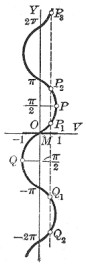
↑Graph of arc sin vIt should be remembered that this function is defined only for values of between -1 and +1 inclusive and that (the function) is many-valued, there being infinitely many arcs whose sines will equal . Thus, in the figure (the locus of ), when . In the above discussion, in order to make the function single-valued; only values of between and inclusive (points on arc ) are considered; that is, the arc of smallest numerical value whose sine is .Template:Clear
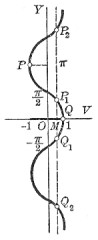
↑Graph of arc cos vThis function is defined only for values of between -1 and +1 inclusive, and is many-valued. In the figure (the locus of ), when . In order to make the function single-valued, only values of between 0 and π inclusive are considered; that is, the smallest positive arc whose cosine is . Hence we confine ourselves to arc QP of the graph.
↑Graph of arc tan vThis function is defined for all values of , and is many-valued, as is clearly shown by its graph. In order to make it single-valued, only values of between and are considered; that is, the arc of smallest numerical value whose tangent is (branch ).Template:Clear
↑Fig. a. Graph of arc cot vThis function is defined for all values of , and is many-valued, as is seen from its graph (Fig. a). In order to make it single-valued, only values of between 0 and are considered; that is, the smallest positive arc whose cotangent is . Hence we confine ourselves to branch AB.Template:Clear
↑Fig b. Graph of arc sec vThis function is defined for all values of except those lying between -1 and +1, and is seen to be many-valued. To make the function single-valued, is taken as the arc of smallest numerical value whose secant is . This means that if is positive, we confine ourselves to points on arc AB (Fig. b), taking on values between 0 and (0 may be included); and if is negative, we confine ourselves to points on arc DC, taking on values between and ( may be included).
↑Graph of y = arc csc vThis function is defined for all values of except those lying between -1 and +1, and is seen to be many-valued. To make the function single-valued, is taken as the arc of smallest numerical value whose cosecant is . This means that if is positive, we confine ourselves to points on the arc AB (Fig. a), taking on values between 0 and ( may be included); and if is negative, we confine ourselves to points on the arc CD, taking on values between and ( may be included).
↑
Defined only for values of between 0 and 2 inclusive, and is many-valued. To make the function continuous, is taken as the smallest positive arc whose versed sine is ; that is, lies between 0 and inclusive. Hence we confine ourselves to arc of the graph (Fig. a).
Template:Clear


 Defined only for values of between 0 and 2 inclusive, and is many-valued. To make the function continuous, is taken as the smallest positive arc whose versed sine is ; that is, lies between 0 and inclusive. Hence we confine ourselves to arc of the graph (Fig. a).
Template:Clear
Defined only for values of between 0 and 2 inclusive, and is many-valued. To make the function continuous, is taken as the smallest positive arc whose versed sine is ; that is, lies between 0 and inclusive. Hence we confine ourselves to arc of the graph (Fig. a).
Template:Clear


